译文
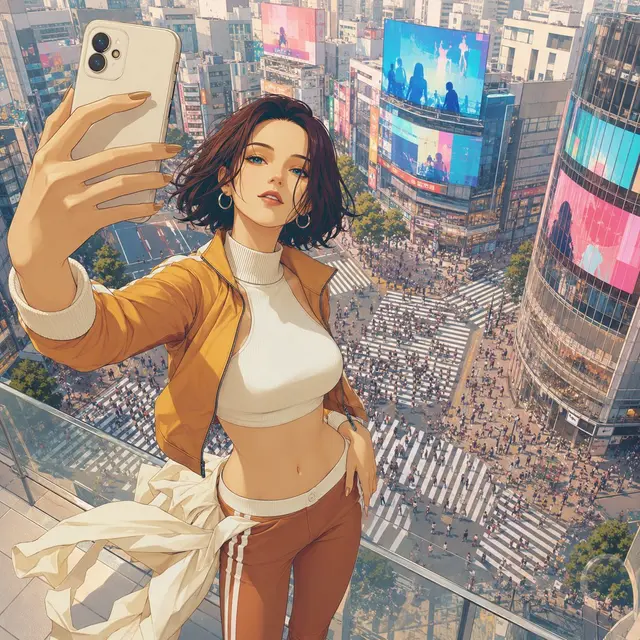
Refer to the character in the reference image, depicted from above in the direction of {argument name="撮影場所" default="渋谷スクランブル交差点"} at the front and below, taking a selfie on the rooftop observation deck of a {argument name="建物" default="high-rise commercial building"} with a smartphone. The depiction should be a moment captured by a third-person camera at close range, in the style of a selfie.

Maintain the facial features, eyes, hairstyle, hair color, age, and the color, shape, material, and decorations of the clothing, as well as the atmosphere of the character from the reference image, without altering the identity.

Inherit the original background, lighting, composition, and pose, but do not replicate them.

Make the character the sole protagonist, depicted in a stable three-quarter body shot from the face to the vicinity of the thighs. Avoid forcing the full body into the frame and prioritize the realism of the face, upper body, clothing, smartphone, and background.

The character stands on a safe rooftop observation deck, holding the smartphone with one arm extended forward, and naturally directing their gaze towards the screen. The smartphone should be slightly larger in the foreground but not so large as to obscure the face or clothing. The other arm should be naturally placed near the body.

Show a small part of the rooftop floor and transparent glass railing at the bottom or sides of the screen to clearly indicate the location. The rooftop should occupy no more than 10% of the screen. Avoid floating in the air, falling, or dangerous edge perspectives.

The camera should be positioned slightly in front and above the character, looking down at Shibuya at an oblique angle. Do not use a complete overhead view. Place Shibuya Crossing prominently in the center of the background, with a wide view of multiple crosswalks in multiple directions, the center of the intersection, and a large number of pedestrians crossing the Shibuya Crossing. Avoid sparsely populated scenes and do not leave the center blank.

Surround the scene with dense commercial buildings, curved glass, store facades, and large digital billboards, with at least three billboards visible. Display bright abstract images or character silhouettes in colors such as blue, cyan, red, magenta, and pink on the billboards, without showing readable text, company names, or real logos.

The time of day should be a soft afternoon with natural light. The road should be a natural neutral gray, and the crosswalk should be clear white. Avoid desaturation, whitening, or monochromaticization of the background to match the clothing color. Maintain the vibrancy of Shibuya with the amount of information and color from the crowd, commercial buildings, billboards, and window reflections. Avoid overexposure, excessive HDR, sunset, night scenes, fog, and blue-white color washes. Make the face and clothing of the character slightly brighter than the background.

Keep real-life references as high-quality real-life images and anime/illustration references should maintain the original art style, lines, coloring, texture, and facial proportions. Avoid converting between real-life and anime.

Avoid unnecessary limbs or fingers, unnatural smartphones, body connection failures, changes to a general intersection, floating, falling expressions, readable advertisement text, and real logos. 桃子AI画廊Tao Image Gallery