译文
Use the provided image as a reference for the character.

Create a scene with the character from the reference image as the protagonist,

"of the theme of the program ("{argument name="番組のテーマ" default="実在しない世界的に有名なパペット番組のワンシーン"}")"

This is not character setting material.

This is not a poster.

This is not a key visual.

This is an actual scene from a fictional puppet program that was broadcast on television.

The program has been broadcast worldwide for decades,

a legendary long-running show loved by multiple generations.

It is well-liked in various countries,

a work with such high recognition that many people say,

"I grew up watching it as a child."

What is being depicted now is a particularly memorable scene from its long history.

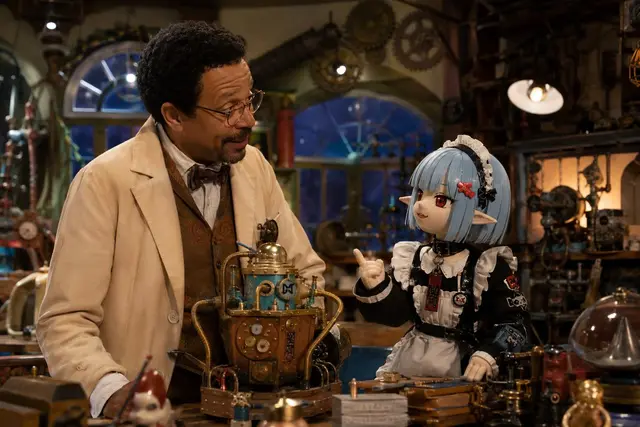
The characters are not anime characters, but high-quality puppets made for television.

They are not costumes.

They are professional puppets made with fabric, felt, foam materials, plastic eyes, stitched mouths, internal skeletons, and joint structures.

They are made as serious puppet performance puppets.

It is okay if there are puppet rods or control mechanisms naturally present in the head, hands, and arms.

It is okay to use puppet strings as needed.

Maintain the facial features, hairstyle, ears, clothing, color design, and personality traits of the character from the reference image while naturally reinterpreting them as a puppet.

There is a real human actor in the scene.

The race, nationality, cultural background, gender, and age of the human actor are not fixed.

Determine them naturally according to the content of the program.

The human actor exists as a character in the program world, such as a host, teacher, researcher, adventurer, clerk, inventor, or a neighbor.

The characters and human actors are naturally conversing.

Since the character is smaller than a human,

use chairs, wooden boxes, desks, benches, counters, stage sets, etc., to make the character's eye level naturally meet that of a human.

The background is a program-specific set built within a large television studio.

Construct an attractive stage according to the story, such as a cityscape, park, library, research institute, shopping street, spaceship, port town, an alien world city, a fantasy village, etc.

The background is not an actual building but a large set made by artisans, which should convey that.

Rich props.

Handcrafted decorations.

Familiar design.

Warm colors.

Elaborately crafted stage props.

A distinctive set design that symbolizes the program.

The character is in the middle of a story.

In the middle of an adventure.

In the middle of an incident.

Exploring.

Chasing.

Celebrating.

Touching reunions.

Strategic meetings.

Failed experiments.

Cooking.

Working.

Solving problems, etc.

Describe a situation that allows viewers to imagine the preceding and following stories.

The lighting is warm and natural.

Soft shadows like stage lighting.

Gentle lighting reminiscent of slightly old television programs.

A children's literature-like atmosphere.

A family-friendly work-like sense of security.

Nostalgia.

Familiarity.

The atmosphere of a renowned long-running program loved for many years around the world.

Do not display text, logos, subtitles, titles, credits, or teletypes within the scene.

High-quality live-action footage.

High-quality puppet design.

High-quality stage set.

Rich descriptions of small items.

A deep composition.

A performance like a scene from a movie.

From a still moment,

emphasize that viewers can feel the long history and story of the program. 桃子AI画廊Tao Image Gallery