译文
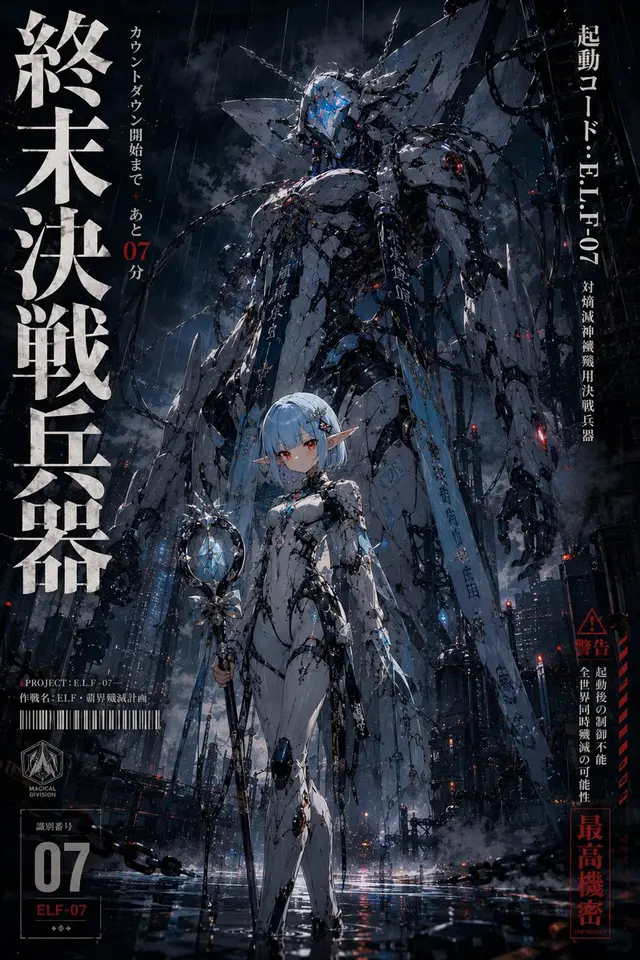
Based on the character from the reference image, create an illustration resembling "Theatrical Key Visual of a Non-existent Legendary Robot Anime Series."

Incorporate the atmosphere of 1990s to 2000s Japanese anime, including:
- End-of-the-world war
- Giant battle weapons
- Biological weapons
- Sealed weapons
- Theatrical anime poster-like ambiance

Emphasize the overwhelming scale difference between the giant weapons and the character, ultra-bold Ming typeface typography, the sense of the end, industrial background, and the atmosphere of "just before the final battle."

Use the reference image as the basis for the character design.

Maintain the character's face, hairstyle, hair color, eyes, silhouette, posture, costume design, and overall impression with high precision.

Absolutely do not distort the character's identity. Do not redraw as a different character.

The character is wearing a near-future combat suit designed for a pilot of the combat weapon that fits their body.

The pilot suit is to be reconstructed based on the character design from the reference image.

Reflect the hair color, eye color, accessories, costume motifs, and silhouette elements naturally into the suit design.

Do not make it just a standard SF suit.

Design it to feel like "this character's exclusive combat equipment."

The character is taking a natural posing that conveys emotions, rather than a static front-facing pose, like in a theatrical anime key visual.

Allow for different body orientations, weight distribution, eye direction, and arm placements.

Accept the following types of poses that feel "static yet strong as an illustration":
- A calm posture that conveys tension before battle
- Turning to look at the viewer
- Lying down and looking up at the distant giant weapon
- Only one arm crossed
- Both arms lightly crossed
- One hand placed on the neck or shoulder
- One hand placed on the waist
- A tired, lazy posture
- A natural standing posture with weight shifted to one leg

The pose should convey the atmosphere of fashion photography, 1990s anime posters, movie posters, and a character's distinctive stance.

Avoid "stick figure setup drawings."

Create natural asymmetry in body angles, shoulder lines, pelvic tilt, and eye direction.

Do not place the character symmetrically in the center of the screen.

The character's stance should have a natural, silhouette-focused performance, like on the cover of a fashion magazine.

Instead of a static pose, capture a moment from the middle of a movement, giving a sense of spontaneity.

Do not keep the camera eye level fixed. Allow the gaze to wander to the distance, ground, giant weapon, warning signs, or sky.

In the background, there should be a giant humanoid combat weapon designed exclusively for the character.

Important:

Do not directly imitate robots from existing works.

However, incorporate the atmosphere of biological weapons,拘束 weapons, and end-of-the-world weapons from 1990s to 2000s Japanese anime.

The machine design should translate the character elements from the reference image.

For example:
- Reflect the flow of the hairstyle in the head silhouette
- Reflect the eye color in the light sensor
- Reflect the costume design in the armor lines
- Reflect accessories in restraint devices or mechanical patterns
- Reflect the character's personality in the machine silhouette

The machine should have a slender, humanoid-like biological weapon silhouette.

Long limbs.
Human-like proportions.
A fusion of biological and industrial feel.

Do not overdo the armor.

Emphasize a smart and eerie silhouette.

Include restraint devices, cables, sealing structures, exposed internal mechanisms, warning lights, biological armor, and damage expressions.

Exude a massive, god-like presence.

Have the unease of a sealed weapon.

Create an atmosphere of "this character's exclusive ultimate weapon."

Do not directly imitate the face structure or head design of existing robot anime.

The composition should be like a theatrical anime key visual.

Foreground:
Character.

Background:
Giant combat weapon.

Create a strong scale difference.

Low angle composition.

An apocalyptic atmosphere.

Industrial city background.

Giant facility.

Rain.

Smoke.

Spark.

Reflections on wet ground.

Warning lights.

Create an atmosphere of "just before the final battle."

Boldly place ultra-bold Ming typeface Japanese typography on the screen.

Vertical writing title.

Warning text.

Identification number.

Operation code.

Graphical composition like a theatrical anime poster.

Integrate the text naturally into the screen design as part of the visual.

High-quality anime illustration.

Filmic presentation.

High density of detail.

Sharp silhouette.

Overwhelming scale.

Aim for a completion level that seems like it would become a trending topic on social media as "a non-existent legendary robot anime series."
 桃子AI画廊Tao Image Gallery