译文
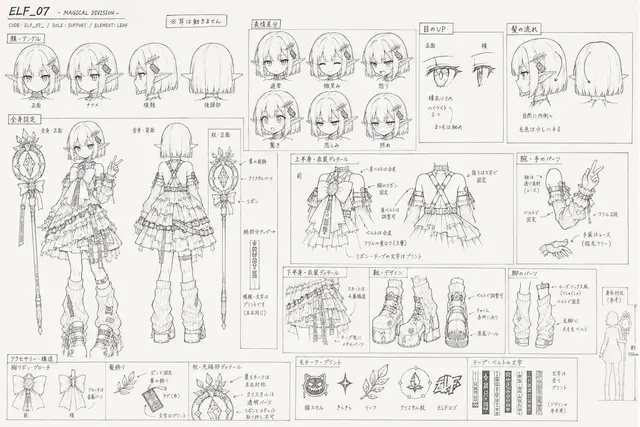
Use the reference image as the basis for character design and draw "a professional character line art setting material used in the commercial anime production field."

Maintain the character's face, hairstyle, hair color, eyes, silhouette, body type, silhouette, costume design, head-to-body ratio, and overall impression accurately.

Absolutely do not destroy the character's identity.
Do not redraw as a different character.

This is not a finished illustration.
It is not concept art.
It is not a poster.

The purpose is,
a drawing sharing setting material for animators, animation directors, and video producers.

The screen is,
a layout of setting material with a white background.

Organize and arrange multiple line drawings as,
material pages.

Include the following:

・Front face
・Diagonal face
・Profile
・Expression variations
・Eye close-up
・Hair flow confirmation
・Full-body front
・Full-body back
・Arm or hand shape confirmation
・Costume details
・Shoe design
・Accessories structure

The character is,
described only with clean anime line art.

Do not color.
Do not flat paint.
Do not thick paint.
Do not render.

The lines are,
thin and organized pencil line art or clean-up line like in Japan's TV anime production field.

Do not be too rough.
Do not become comic line.
Do not overdo the sketchiness.

As a field setting material, prioritize readability and structural understanding.

Naturally add small handwritten notes,
arrows,
parts instructions,
simple annotations,
costume structure notes,
hair flow instructions, etc., within the page.

The layout is,
like the atmosphere of a Japanese anime setting material collection from the 1990s to 2000s.

The information density is high, but well-organized and easy to see.

Allow natural white space on the paper.

The entire page is,
like the atmosphere of a scanned physical setting material collection.

Naturally add slight paper texture,
a little printing feel,
copy paper feel,
and scanning feel.

Prioritize looking like "actual production materials" rather than a finished art piece.
 桃子AI画廊Tao Image Gallery