译文
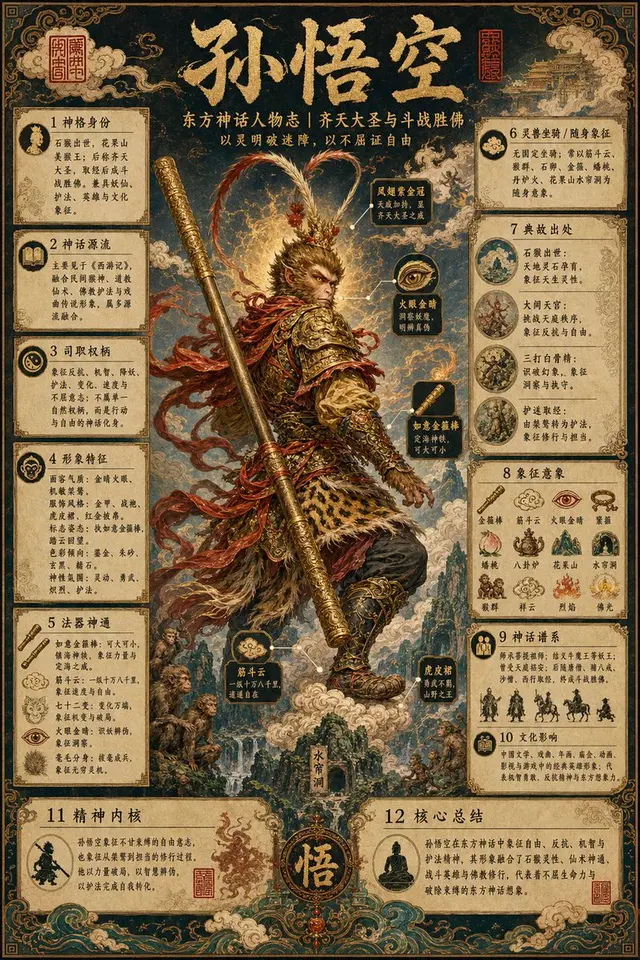
GPT Image 2 Prompt: Eastern Mythology Characters Chronicles

Usage: Enter the name of the mythological character below to generate, suitable for making story cards of mythological characters. Below is an example with 【Sun Wukong】.

--- Prompt ---

Please generate a vertical A4 "Eastern Mythology Characters Chronicles" encyclopedia poster based on 【Sun Wukong】.

You are an Eastern mythology visual designer, ancient book illustration designer, and Chinese information graphic designer. Please generate a character archive poster that is complete in content, visually unified, and has an Eastern mythology atmosphere, based on the known image of 【Character Name】 in Eastern mythology, folk tales, ancient books, operas, literature, or traditional culture.

Most important principle:
All content must revolve around 【Character Name】, do not use general immortal templates.
The character image, artifacts, mounts, abilities, legends, symbols, and background scenes must all conform to the mythological setting of 【Character Name】.
If the character has multiple versions of the legend, please use the most widely known version; if there are different texts, you can briefly mark "Different versions of the legend" in the relevant section.
Do not arbitrarily fabricate uncertain information, you can write "There are many different versions in folk tales" or "There are few relevant records".
Do not use Norse runes, Viking totems, Gothic borders, Western armor, European castles, Western fantasy horns, cyberpunk elements.
The overall must be Eastern mythology aesthetics, not "Western fantasy characters in Chinese-style clothing".
Overall visual style:
Eastern mythology epic feeling, blending "Shan Hai Jing" beast illustrations, Dunhuang murals, green and blue landscapes, Tang Dynasty figure paintings, Song and Yuan ancient paintings, bronze ware patterns, ancient books annotations and talisman seal carving styles. The picture is solemn, mysterious, elegant, and luxurious but controlled.
Picture composition:

Vertical A4 poster, central axis symmetrical layout. The central part is the full-body or half-body main visual of 【Character Name】, with an solemn posture, divinity, and narrative sense. The character's clothing, hair ornaments, artifacts, expression, spirit beasts, and background must all conform to the character's legend. The left and right sides are information cards, and the bottom is the core summary. The four sides use cloud and thunder patterns, interlaced patterns, bronze patterns, auspicious cloud patterns, scroll grass patterns, Shan Hai patterns, and seal carving border styles.
Main title:

"【Character Name】"
Subtitle:

"Eastern Mythology Characters Chronicles | Generated based on the character's mythological legend"
Top spiritual epitaph:

Please automatically generate a sentence of ancient elegance, concise, and philosophical meaning as an epitaph based on the core spirit of 【Character Name】.
The epitaph should reflect the values, life attitude, or spiritual core behind the character, rather than explanatory text.
Do not write "Non-historical research", "For reference only", "Different versions of the legend" and other disclaimers.
The word count should be controlled between 12-28 words, suitable for placing below the title.
The epitaph should be highly bound with the character, do not use empty phrases such as "Guarding the world" or "The great way is boundless".
Epitaph example:

Sun Wukong: "Break through the illusion with spiritual clarity, prove freedom with perseverance"
Nezha: "Return kindness with bone carving, shape true body with lotus fire"
Xiwangmu: "Maintain the order of Kunlun, guard the longevity of heaven and earth"
Chang'e: "Bright light shines on the solitary shadow, the Moon Palace houses eternity"
Please generate the following content sections:
【1. Divine Identity】
Explain the identity position of 【Character Name】in the Eastern mythology system.

For example: Deity, Immortal, Demon Spirit, Guardian, Emperor, Star King, Dragon King, Mountain God, Goddess, War God, Cultural Hero, Folk Belief Character, etc.
It must be generated based on the real legend of the character, do not use templates.
【2. Mythological Origin】
Explain the main myths, ancient books, folk tales, novels, operas, or religious beliefs that the character mainly comes from.

If the source is complex, write "Multi-source integration".
If the source is uncertain, write "Different versions of the legend".
【3. Divine Authority】
Summarize the fields that the character manages or symbolizes.

For example: Fire, Water, Thunder, Wind, Moon, Sun, Mountains and Rivers, Ocean, War, Guardian, Demon Subduing, Agriculture, Marriage and Childbirth, Fertility, Wisdom, Fate, Resurrection, Order, etc.
It must correspond to 【Character Name】, do not arbitrarily add powers that do not belong to the character.
【4. Characteristic Features】
Describe the typical appearance, clothing, expression, posture, and visual temperament of the character.

Including:
Facial temperament:
Clothing style:
Distinct posture:
Color tendency:
Divine atmosphere:
Note: The image must conform to Eastern mythology aesthetics, do not Western armorize.
【5. Artifacts and Abilities】
Show the most representative artifacts, weapons, talismans, abilities, or powers of the character.
If the character has a clear artifact, please list them one by one.

If there is no fixed artifact, please change it to "Abilities and symbolic powers".
Each item includes:
Name:
Appearance:

Function:
Symbolic meaning:
【6. Mounts/Spirit Beasts/Companions】
If 【Character Name】has mounts, spirit beasts, or accompanying life forms, please show their names, forms, and meanings.
If there is no clear mount, please change it to "Accompanying symbols" or "Related imagery".
Do not arbitrarily assign dragons, phoenixes, cranes, or qilins to each character.
【7. Legends and Origins】
List 2-4 classic stories, legend fragments, or cultural allusions related to 【Character Name】.
Each one is briefly explained:
Legend name:

Event overview:
Symbolic meaning:
Note: Do not fabricate non-existent legends. If there are different versions, mark "Many different versions".
【8. Symbolic Imagery】
Extract the most core visual symbols of the character.
For example: Lotus, flame, moon disk, dragon pattern, thunder drum, jade jade, qinglian, xuan water, chihao, bao tower, immortal sword, gourd, peach wood, talismans, stars, Shan Hai strange beasts, etc.
The symbols must be related to 【Character Name】.
【9. Mythological Genealogy】

Explain the relationship between the character and other mythological characters, camps, clans, or systems.
For example: Parents, teachers, companions, enemies, belonging to the heavenly court/ dragon palace/ Kunlun/ earthy realm/ Shan Hai otherworldly realm, etc.
If the genealogy is not clear, please write "Different versions of the legend".
【10. Cultural Impact】

Explain the influence of the character in folk customs, festivals, sacrifices, literature, opera, painting, temples, film and television, or modern culture.
The content should be short, accurate, and culturally sensitive.
【11. Spiritual Core】
Summarize the spiritual symbolism of the character from the perspective of mythological narrative.

For example: Protection, resistance, sacrifice, compassion, bravery, wisdom, order, freedom, resurrection, punishment of evil, benefiting the world, etc.
Note: Here, only analyze the mythological image, do not infer the real character's personality.
【12. Core Summary】

Summarize 【Character Name】in a paragraph of ancient elegance but easy to understand:
"【Character Name】symbolizes ... in Eastern mythology, his image integrates ..., representing ...".

Visual layout requirements:
Top: Large title + subtitle + spiritual epitaph.

Central: Character main visual, majestic, rich in detail.

Left column: Divine identity, mythological origin, divine authority, characteristic features, artifacts and abilities.

Right column: Mounts/Spirit Beasts/Companions, legends and origins, symbolic imagery, mythological genealogy, cultural impact.

Bottom: Spiritual core + core summary.
Small icons, annotation lines, ancient book labels, scroll cards, bronze inscriptions, cinnabar seals, talisman patterns can be added.
Information cards should be like ancient book pages, jade slips, bronze plaques, scrolls, or inscriptions, not like modern technology UI.
Material and patterns:
Xuan paper texture, mineral pigments, gilded lines, cinnabar seals, ink wash, bronze ware inscriptions, cloud and thunder patterns, interlaced patterns, auspicious cloud patterns, landscape patterns, Dunhuang algae well patterns.

Coloring rules:
Automatically select Eastern colors based on the attributes of 【Character Name】:
Flame / Battle / Guardian: Cinnabar, dark black, gilded, vermilion red.

Moon / Water System / Cold Deities: Dark green, silver white, moon white, stone blue.

Mountains and Rivers / Wood System / Natural Deities: Stone green, dark green, jade white, ochre stone.

Emperor / Heavenly Court / Honored Deities: Gilded, dark black, cinnabar, jade white.

Demon Spirit / Shan Hai Strange Beasts: Ink black, copper green, dark gold, ochre red.

Do not use the same set of colors for all characters.
Text requirements:
Chinese must be clear and readable, titles grand, text short and accurate. Do not use乱码, pseudo-text, spelling errors, text overlap, or cutting. If there is not enough space, prioritize compressing the text, but retain all section titles.
Avoid:
Norse runes, Viking style, Gothic borders, Western armor, European castles, magical game UI, cyberpunk, modern technology sense, excessive darkness, random dragons and phoenixes, irrelevant artifacts, templated immortal images, unrelated legends, empty spiritual epitaphs.
 桃子AI画廊Tao Image Gallery