译文
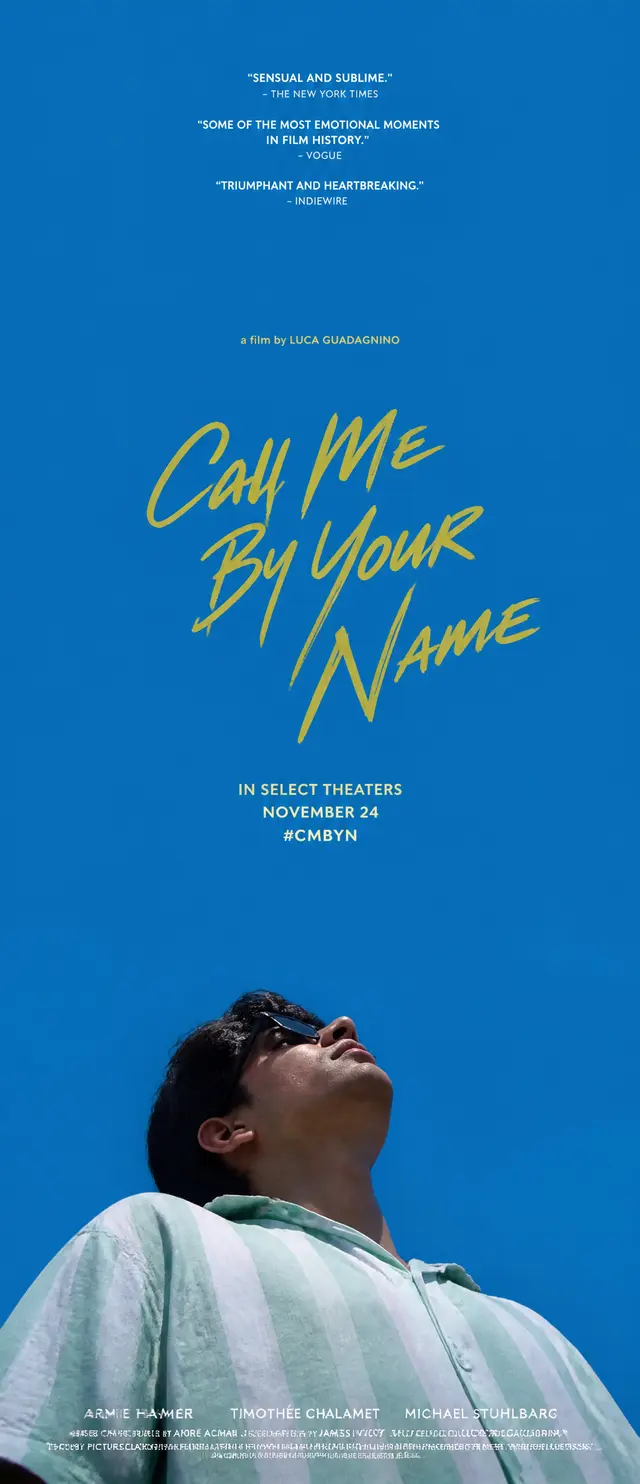
Create a movie poster-style portrait based on the user-provided photo, with the core concept being a vast expanse of pure color field supporting the subjects who are leaning against the edges of the image, each gazing up at the sky. Approximately three-quarters of the entire image is a solid, saturated, and debris-free monochromatic field, resembling an infinitely distant sky, creating a sense of openness, longing, and summery breathing space; the subjects occupy only a narrow band on one side of the image, about a quarter of the width, leaving most of the space to the vast color field. The composition adapts to the aspect ratio: in portrait mode, the subjects are aligned along the bottom of the image in a low horizontal row, with the sky extending upwards; in landscape mode, the subjects are aligned along one side of the image (such as the left side) in a vertical row, with the vast color field spreading out to the other side (such as the right side), with text placed in that open space; regardless of the orientation, the subjects and text are always on opposite ends, with negative space dominating. The camera angle must be a very low angle shot from below (bug's perspective): each character's head is tilted back, the chin raised, and the neck stretched, facing upwards towards the vast color field at the top, with the viewer primarily seeing the lower jawline and the silhouette or three-quarter profile of the side face or three-quarter face—the characters never face the camera directly, never make eye contact with the camera, never pose for a frontal ID-style portrait, and their gaze is not directed towards the viewer but towards the sky above. Only the head, shoulders, and a small part of the upper body are visible, with the bottom edge naturally cut off by the image edge.

There are no restrictions on the subject objects; everything is based on the real objects appearing in the input photo; their identity, quantity, type, and combination must strictly correspond to the original photo, without any arbitrary proliferation, duplication, breeding, or addition of objects outside the image. The key posture of leaning is mutual support rather than looking in the same direction: each object is leaning against the back of the other, heads touching heads, or one side's back and side of the head leaning against the other's shoulder and neck, leaning towards opposite or different directions, each object tilting their heads upwards towards their own side of the sky, their gaze scattered towards different directions of the vast color field, rather than converging on a single focal point; each object maintains a raised chin and an upward gaze, conveying a sense of leaning, intimacy, and each being lost in thought. Unless the user explicitly requests repetition or mirroring, do not replicate the same face or object multiple times.

Place handwritten, brushstroke-thin, and slightly connected title text in the vast empty space away from the subjects, with a casual, slightly slanted, and hand-drawn feel, arranged in two to three lines in a staggered layout, using a bright contrasting color (a bright yellow tone, which can be slightly adjusted according to the theme emotion) that forms a warm contrast with the main color field, making the text appear as if floating in the air. The default content of the title text is the handwritten English "Call Me By Your Name," which is only replaced with the user-specified content if the user provides custom text. The position of the title text adapts to the aspect ratio: in portrait mode, it is placed in the upper middle of the upper empty space, and in landscape mode, it is placed in the central large blank space opposite the subjects. Place a line of smaller, thin, explanatory text above the title (default "a film by …" style), and two to three lines of smaller, highlighted or white uppercase information lines below the title (default "IN SELECT THEATERS / NOVEMBER 24 / #CMBYN" such as theater release and tagline, which the user can customize); in the portrait version, an additional few lines of extremely small white quote-style short sentences can be stacked in the center at the top, and a line of white uppercase names of the lead actors and a dense,低调, small copyright information strip can be placed at the bottom, forming a complete movie poster text order.

The main color field defaults to the original work's pure, saturated, slightly deeper cobalt blue/azure color—like the clear blue of a midday summer sky, approximately #0A66AC (red very low, green in the middle, blue higher), distinctly blue without greenish, gray, purple, lavender, or dark blue tones; it is only replaced with other theme colors if the user specifies, while still maintaining the same purity, saturation, and high lightness relationship. The overall color role is: a large single pure high lightness color field dominates, a warm handwritten highlight color (default bright yellow) serves as a highlight, white text carries information, and characters retain their real natural skin and clothing colors. The image is bright, transparent, clean, saturated, and not dirty, with a gentle sense of openness and longing; even if a deeper color field is chosen, it must maintain a clear light sense, clear color gradation, and breathable negative space, avoiding gray, worn, stuffy, dirty, or aged. The visual weight is firmly focused on the contrast between the vast empty space and the subjects gazing upwards from the edge, with the subjects never filling the entire frame, never shot straight-on, and never losing the large blank space and upward scattered gaze.
 桃子AI画廊Tao Image Gallery