译文
[Theme]:
[English Theme]:
[Exhibition Name]:
[Date]:
[Venue]:
[Aspect Ratio]: 9:16

Design a set of 4 complete Eastern contemporary culture poster designs around the same [Theme]. The four posters should maintain consistent themes, core texts, and basic exhibition information, but must employ 4 distinctly different graphic design languages. The focus should not be on simply changing colors, but rather on altering composition, font scale, image organization, information structure, materials, and visual rhythm, making it clear at a glance that these are "four design solutions for the same theme".

Overall, refer to the visual, editing design, and aesthetic of mature Eastern culture exhibitions, art museums, and contemporary graphic poster design. Combine traditional Eastern elements with modern design languages. Each poster must be a complete work in itself, with clear thematic expression, main visual, auxiliary images, text hierarchy, and information system, and should not be just a template illustration with only a title and background.

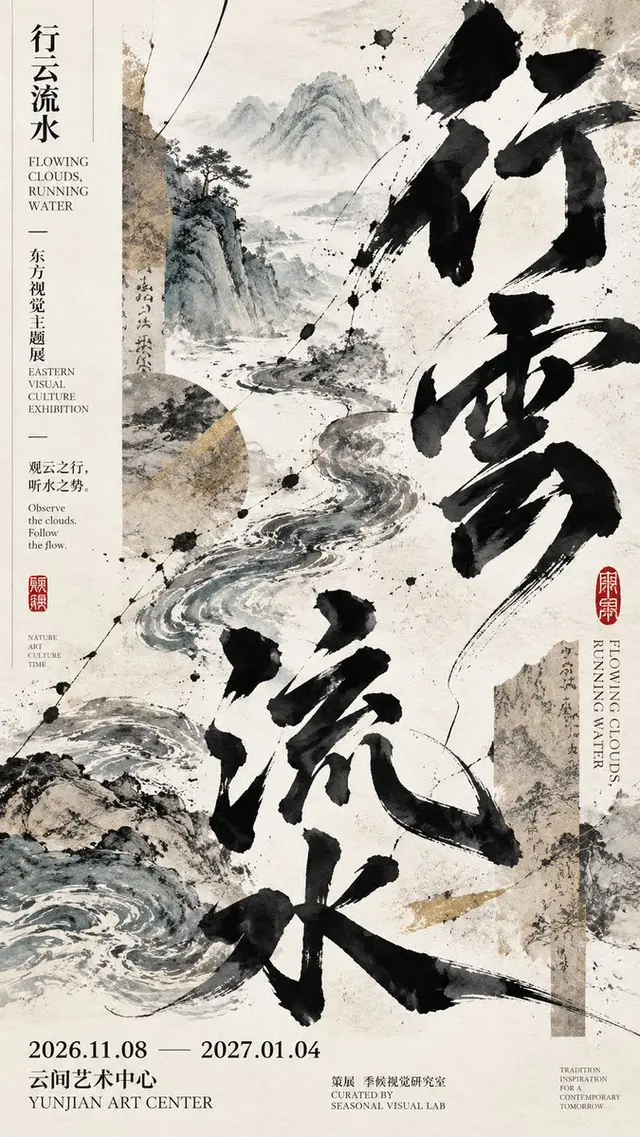
First, the [Ink wash deconstruction style]: Use warm white rice paper, large areas of blank space, large-scale freehand calligraphy, ancient painting fragments, water ripples, mountain shapes, clouds, and ink stains for asymmetric collage. The large-scale Chinese calligraphy directly serves as the composition framework, overlapping, cutting, and interweaving with ancient paintings, water ripples, and ink stains, while also adding a small amount of modern Chinese and English editing information and cinnabar seals. The overall color scheme is black, white, and gray, with a free and tense visual, and a sense of Eastern experimental art and modern editing design.

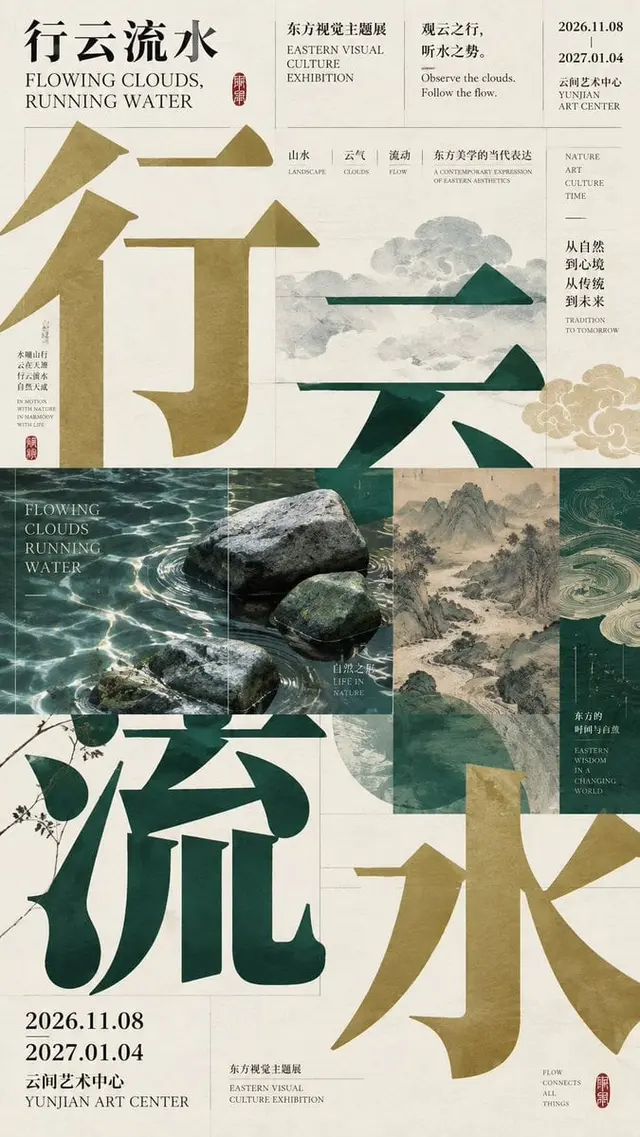
Second, the [Modern exhibition style]: Use strict modern editing grids, oversized Chinese characters, horizontal image sample strips, and a fine small information system. Organize Eastern natural materials, local sections of ancient paintings, patterns, objects, or photographic images like museum research archives. Colors can include milky white, ink green, celadon gray green, cream yellow, and other restrained combinations, making the large text first a geometric composition and then readable as the theme. The overall visual should have a professional sense of cultural institutions, art museums, and design exhibitions.

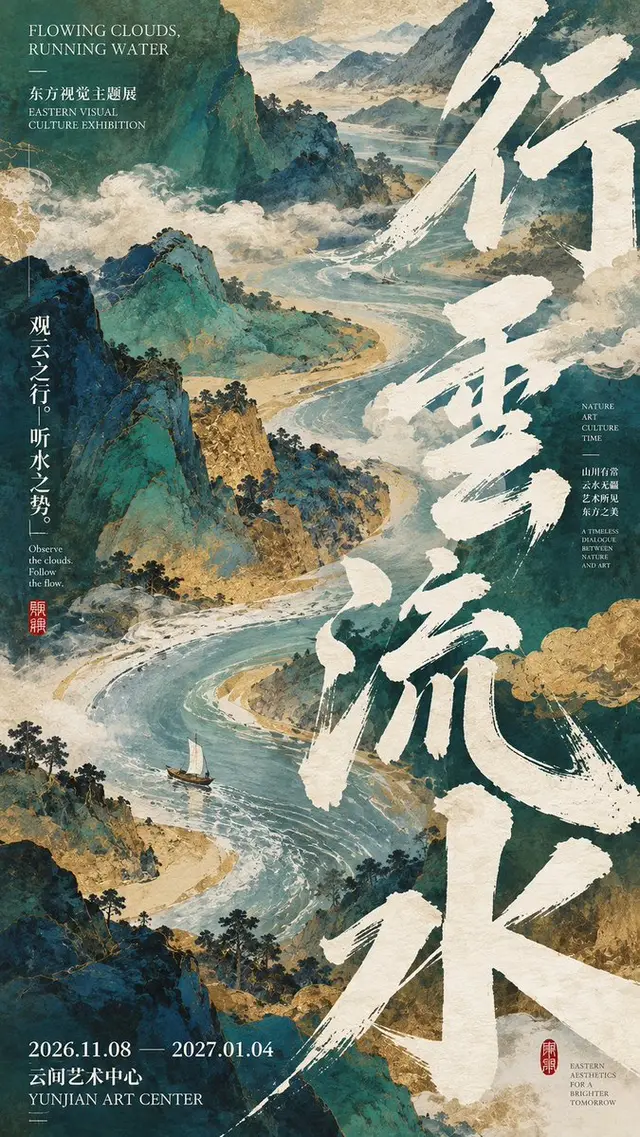
Third, the [Color ink giant character style]: Use Eastern mineral colors such as celadon blue, green, ochre gold, gray blue, and milky white to create a nearly full-page landscape color field. Form a continuous visual momentum through elements such as rivers, clouds, and mountains, and then overlay oversized ivory white calligraphy. The text must truly overlap, interweave, and have spatial relationships with the landscape, rather than simply pasted on the background. From a distance, the strong color field and large text are seen first, and then the natural landscape and details are discovered up close.

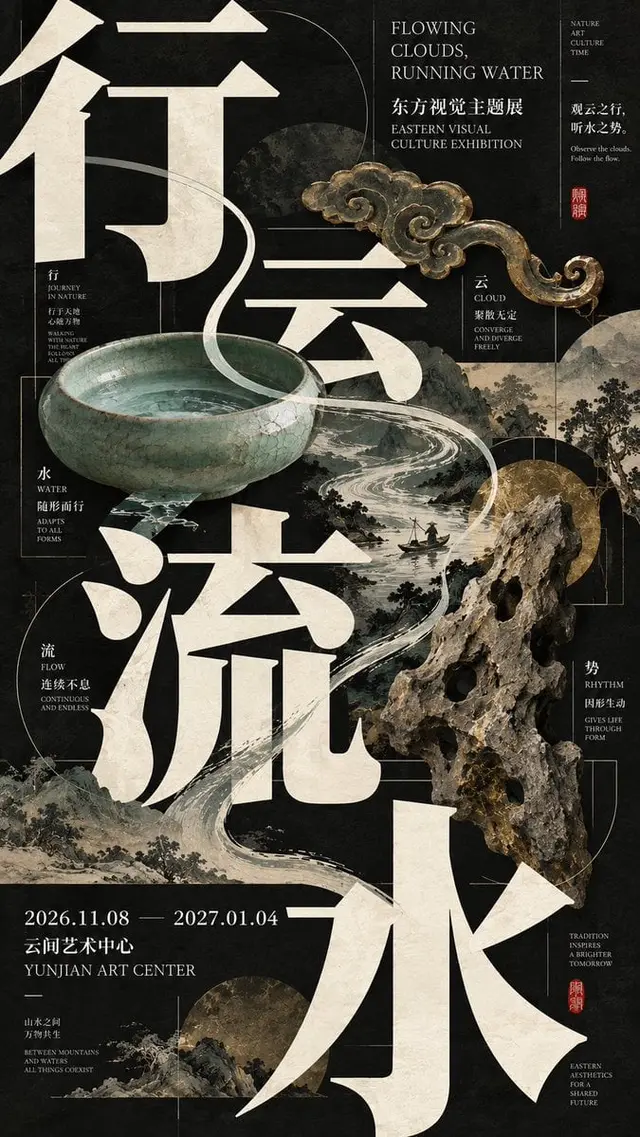
Fourth, the [Black background deconstruction style]: Use a deep charcoal black background, large-scale ivory white modern Chinese characters, Eastern objects, rocks, flowing cloud patterns, ancient painting silhouettes, and continuous curves for collage. Add a restrained geometric frame, fine lines, exhibit annotations, and a museum archive-style information system. The overall color scheme is black, ivory white, celadon gray green, antique gold, and a very small amount of cinnabar, making traditional cultural materials present the visual quality of contemporary art exhibitions, design biennales, and high-level cultural institutions.

The four posters must maintain clear series sense: the theme is completely consistent, the Chinese and English core titles are consistent, the basic exhibition information is consistent, and a few Eastern cultural identification elements are retained. However, the four must form clear differences in composition methods, visual focus, font expression, color system, image materials, and information organization, and cannot just be the same template with different colors or background changes.

Each poster must establish a clear three-level visual hierarchy: the first level is a strong large main visual or giant theme text; the second level is Eastern cultural images, landscapes, objects, ancient paintings, or other thematic visual materials; the third level is Chinese and English exhibition information, date, venue, explanatory text, and a few seals. From a distance, there should be clear large shapes and visual focus, and up close, there should be rich graphic relationships and design details.

Ensure that the work has sufficient information density, layout design sense, and completeness. Do not cut corners, and do not just generate "background image + centered title"; truly process the interweaving, overlapping, cutting, proportion, blank space, hierarchy, and reading path between text and images, making each poster seem like a culturally designed poster by a professional graphic designer.

Avoid cheap national fashion, ancient style game UI, tourism promotional posters, ordinary landscape paintings with added text, four posters only changing colors, excessive symmetry, full-screen small elements, random decorations, meaningless English, scrambled text, numbers, and corner starbursts.

The four posters must be generated separately, and not merged into a four-panel grid or puzzle.
 桃子AI画廊Tao Image Gallery